
Silicone high voltage cable combines electrical insulation with a soft, flexible covering that is practical to route around a high-voltage assembly. Its advantages are particularly useful when connecting a DC supply, flyback transformer output, voltage multiplier or measurement network: the cable can follow a planned route without a stiff jacket pulling on every terminal.
The right cable still depends on more than the word “silicone.” Voltage rating, conductor size, insulation construction, operating temperature and termination design each answer a different question. This guide explains the benefits and limitations, then compares HVE’s 40 kV, 50 kV and 100 kV DC high-voltage cables so you can choose a construction that fits your application.
In this guide: Silicone’s advantages · Cable construction · 40, 50 or 100 kV? · Voltage and current · Terminations and routing · Cable capacitance · Selection checklist · Common questions
Why choose high voltage silicone wire?
Flexible insulation makes cable routing easier
A soft silicone covering bends readily around an assembly. Combined with a stranded conductor, it makes the lead easier to position during assembly and later maintenance. That matters when a cable must reach a transformer terminal or a multiplier output while keeping a deliberate distance from grounded metal, control wiring and adjacent high-voltage nodes.
Flexibility also lets you provide a relaxed service loop instead of forcing the terminal to carry the cable’s bending load. Secure the cable separately: a soft jacket does not replace strain relief, and “flexible” does not establish a continuous-flex or drag-chain lifetime. Use the specified minimum bend radius where available; do not infer one from how tightly the cable can be bent by hand.
Useful flexibility across a broad temperature range
Silicone elastomers are used in electrical insulation partly because they combine flexibility with resistance to temperature extremes. Dow’s electrical-protection materials overview identifies both properties as advantages of formulated silicone materials. The actual finished cable’s specification remains the limit to use.
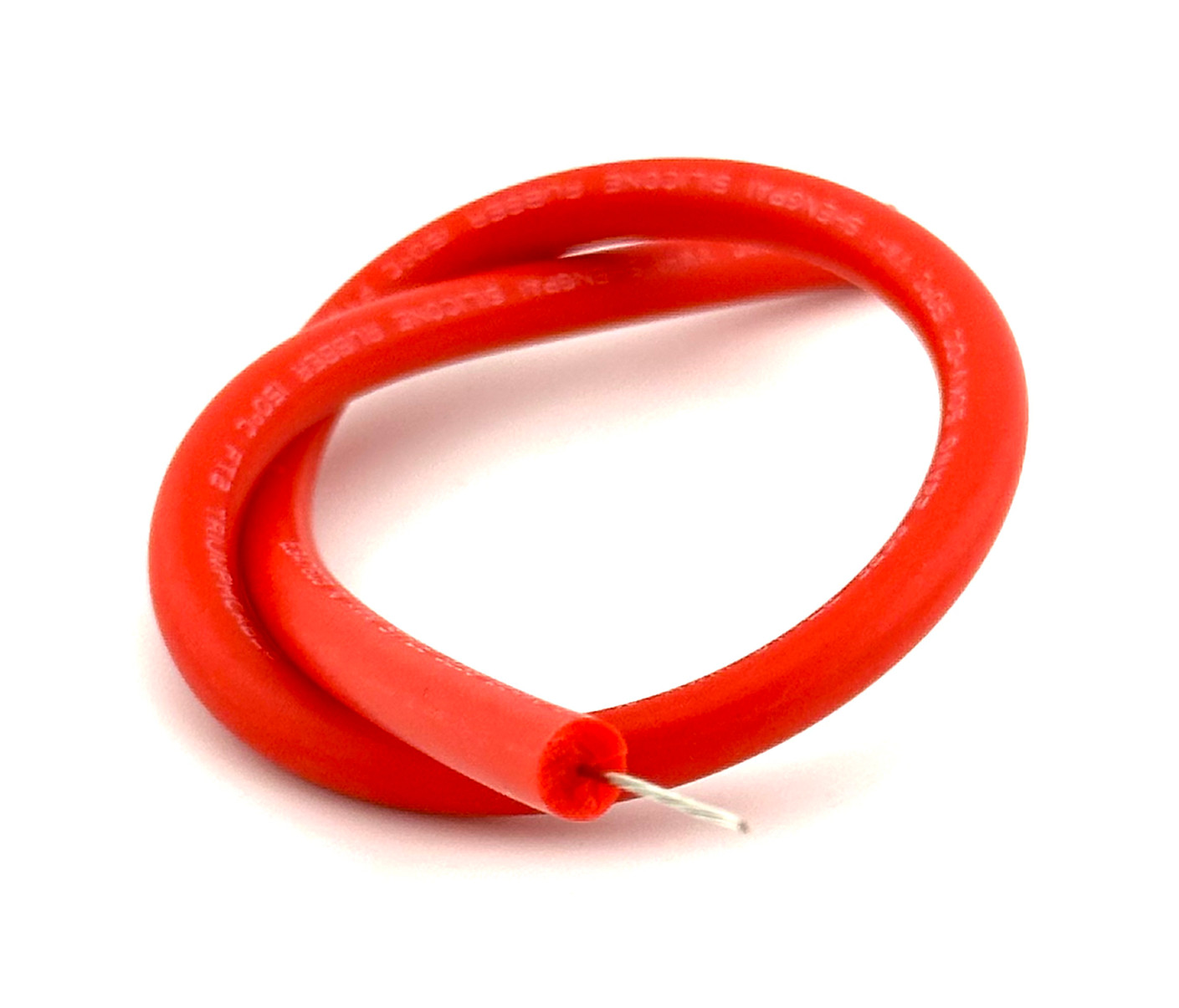
All three HVE cables compared here list a temperature range of −55 to +150°C. That can be useful near warm electronics or in equipment exposed to changing ambient temperatures. The upper rating is not a target operating temperature or an assurance that every nearby connector, adhesive and support tolerates the same heat. Account for ambient temperature and conductor heating together.
A practical insulation system for high-voltage connections
Silicone rubber can form a thick, compliant insulating layer around a comparatively small conductor. In many high-voltage experiments, insulation and spacing occupy more room than the copper needed to carry the load current. A flexible covering makes that necessary insulation easier to accommodate.
This is also why ordinary low-voltage silicone hook-up wire is not a substitute for rated high-voltage wire. Two cables can use the same broad material family while having very different insulation thicknesses, constructions and voltage ratings. Choose the complete cable, not just its material name.
What is inside HVE’s silicone HV cables?
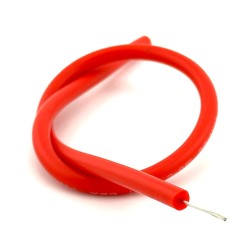
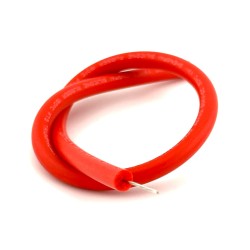
HVE’s 40 kV and 50 kV DC cables use a 22 AWG tinned stranded copper conductor and soft silicone rubber insulation. The product specifications quote a 0.64 mm conductor diameter. Their different outside diameters reflect different finished constructions; they do not indicate a larger copper conductor in the 50 kV version.
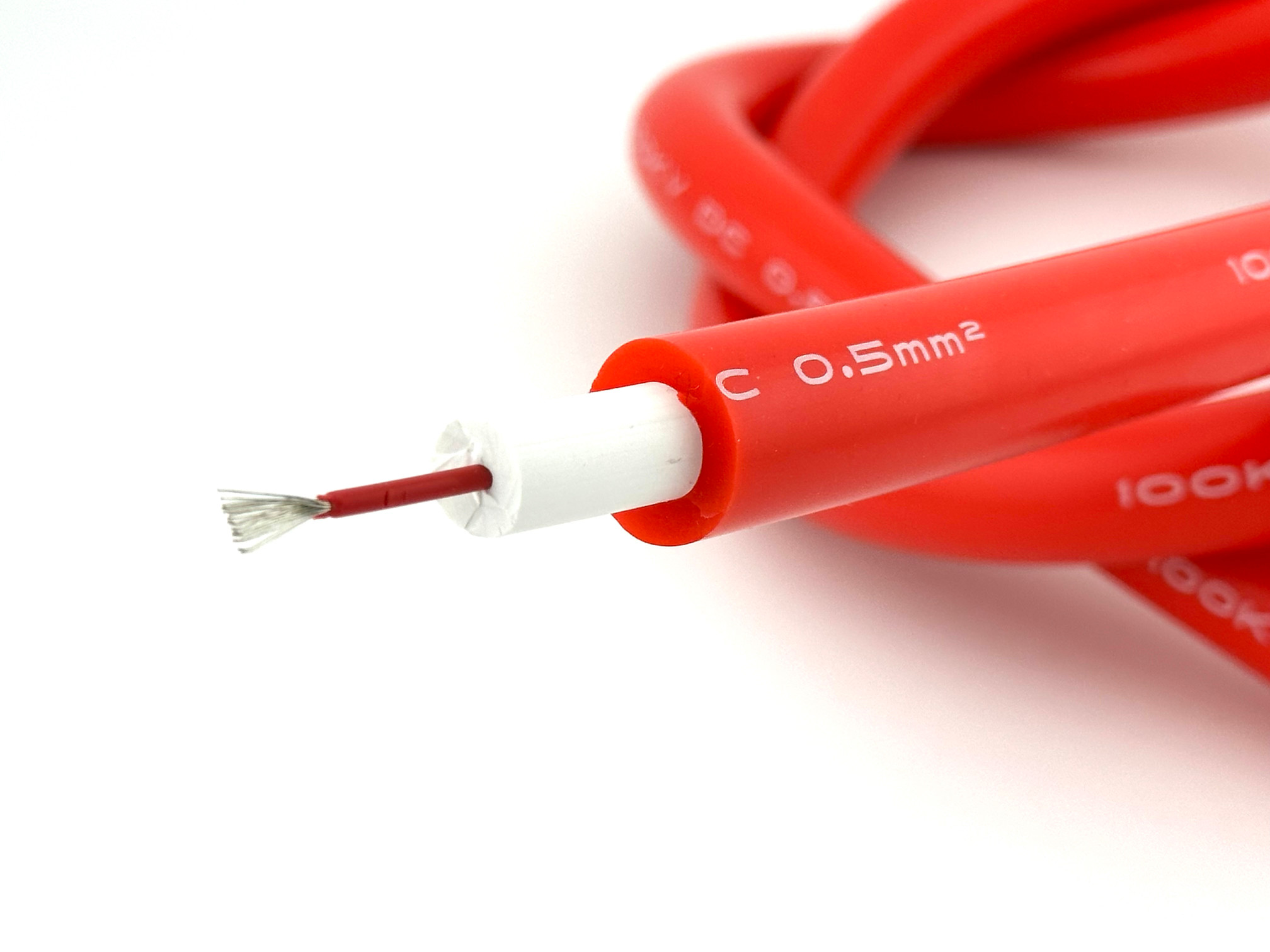
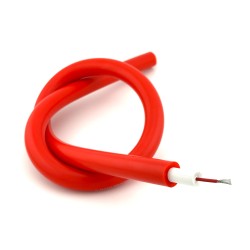
The 100 kV DC cable has a different layered construction: a nominal 0.5 mm² conductor, approximately 20 AWG, made from 19 strands of 0.19 mm tinned copper; an inner FEP layer; a white silicone layer; and a red silicone outer layer. Its total outside diameter is 17 mm.
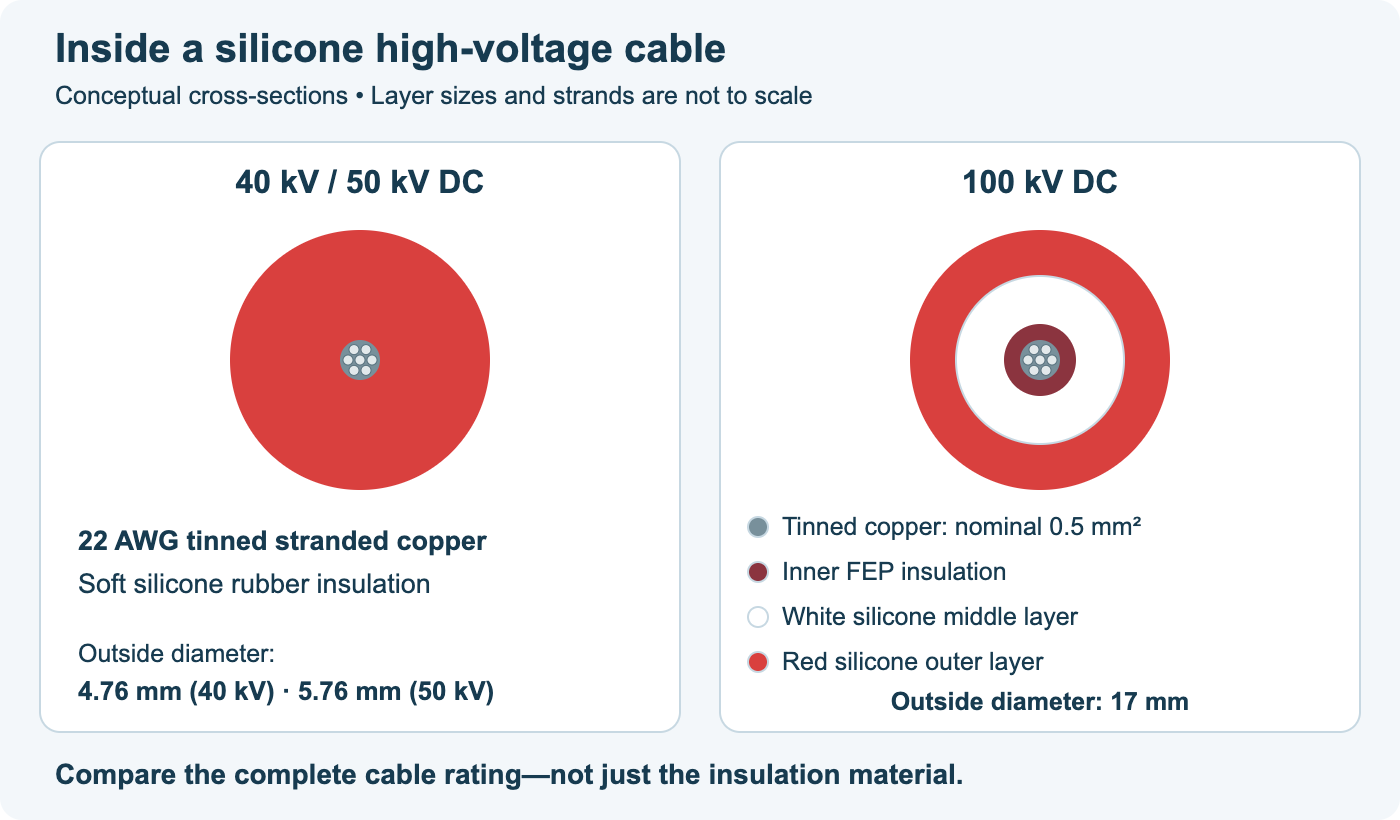
FEP is a fluoropolymer, while silicone is an elastomer. Their presence in one cable illustrates an important point: a useful high-voltage insulation system can combine materials. Its performance belongs to the finished construction, including layer interfaces and manufacturing quality. Dividing a voltage rating by the outside diameter does not produce a dependable design rule for another cable.
Choosing between 40 kV, 50 kV and 100 kV DC cable
| Cable | Conductor | Insulation | Outside diameter |
|---|---|---|---|
| 40 kV DC | 22 AWG, tinned stranded copper | Soft silicone rubber | 4.76 mm |
| 50 kV DC | 22 AWG, tinned stranded copper | Soft silicone rubber | 5.76 mm |
| 100 kV DC | Nominal 0.5 mm² / approximately 20 AWG; 19 × 0.19 mm strands | FEP plus two silicone layers | 17 mm |
All three list −55 to +150°C operation and are sold per metre, with quantities above one supplied as a continuous length. A continuous lead avoids introducing an unnecessary mid-cable joint. Check current product details when ordering, especially where the assembly depends on a particular dimension or approval.
The 40 kV cable offers the smallest outside diameter of these options. The 50 kV version provides a higher specified DC insulation rating with the same nominal conductor gauge, but needs more routing space. The 100 kV version requires a much larger cable entry and more generous mechanical accommodation.
For example, a nominal 30 kV DC supply may make the 40 kV cable worth evaluating. Selection still depends on maximum open-circuit voltage, overshoot, ripple, surrounding conductors and the termination arrangement. Choosing 100 kV cable does not raise the rating of a 30 kV connector or make an inadequately spaced terminal acceptable. Use an engineering margin based on the actual duty, rather than a universal percentage.
Voltage rating, current capacity and waveform are separate checks
A DC cable rating is not an AC or pulse rating
These HVE cables are specified for DC voltage. A 50 kV DC label does not automatically permit 50 kV RMS AC, repetitive 50 kV pulses or a particular switching frequency. For a sine wave, peak voltage is √2 times RMS voltage, but that conversion alone does not qualify DC-rated insulation for AC service. Repeated electric-field changes, dielectric losses and discharge behavior also matter.
Describe the actual waveform when checking suitability: maximum voltage, polarity, ripple, rise time, pulse duration and repetition rate. A rectified flyback output and an unrectified AC secondary can impose different duties. Our AC vs DC flyback transformer guide explains that distinction, while the Cockcroft–Walton multiplier guide covers loaded DC output and ripple.
More kilovolts does not mean more amps
The voltage rating addresses insulation stress. Current-carrying capacity depends on conductor size, resistance, temperature, bundling, cooling and the installation. HVE’s 40 kV and 50 kV cables both use 22 AWG conductors, so the higher voltage label is not evidence of a higher current rating.
Conductor heating follows P = I²R. For unchanged resistance, doubling current produces four times the heating. Pulse applications also need peak-current and connection checks. The product pages do not specify an installation-independent ampacity, so do not select a current limit from the kV rating or the thick appearance of the insulation.
What does UL3239 mean?
The 40 kV and 50 kV product listings identify UL3239. UL AWM style numbers describe appliance-wiring constructions and associated requirements. UL’s AWM guidance explains that ratings depend on construction and intended use, and that Product iQ is used to verify certified wiring.
For an equipment approval, check the actual wire marking, supplier documentation and applicable recognition record. A style number alone does not certify the finished assembly. The 100 kV listing does not state UL3239; do not transfer that claim from the other two cables.
Good cable still needs good terminations and routing
The cable end is where insulation stops and the electric field encounters a new geometry. Sharp strands, damaged insulation, contamination and nearby metal can concentrate stress or create a discharge path. A cable’s headline voltage rating does not establish the withstand voltage of that exposed connection.
Clearance is distance through air; creepage follows an insulating surface. Both depend on the assembly and environment. Altitude, contamination, humidity, geometry and waveform prevent a single “millimetres per kilovolt” shortcut from qualifying every connection. Use suitably rated terminals, feedthroughs and enclosures, and validate the completed arrangement for its intended duty.
Protect soft insulation from sharp chassis edges, pinching and abrasion. Provide appropriate cable-entry protection and strain relief without crushing the jacket. Keep supported bends away from the stripped end, and use a stripping process that does not cut strands or damage the remaining insulation. A flexible cable should simplify a sound route, not justify a tighter gap.
Where an approved connector arrangement calls for it, silicone dielectric grease can help exclude moisture and fill small interface gaps. Check compatibility and the connector’s instructions. Grease is an insulating accessory, not a structural insulation system, a repair for cut cable or a way to increase the cable’s voltage rating.
The constructions described here are not shielded coaxial cables. Do not assume their outer surface is a grounded screen or a touch-safe barrier. If the equipment needs a grounded shield, controlled impedance or a specified low-noise cable arrangement, select a cable and termination system designed for that requirement.
Cable length adds capacitance and stored energy
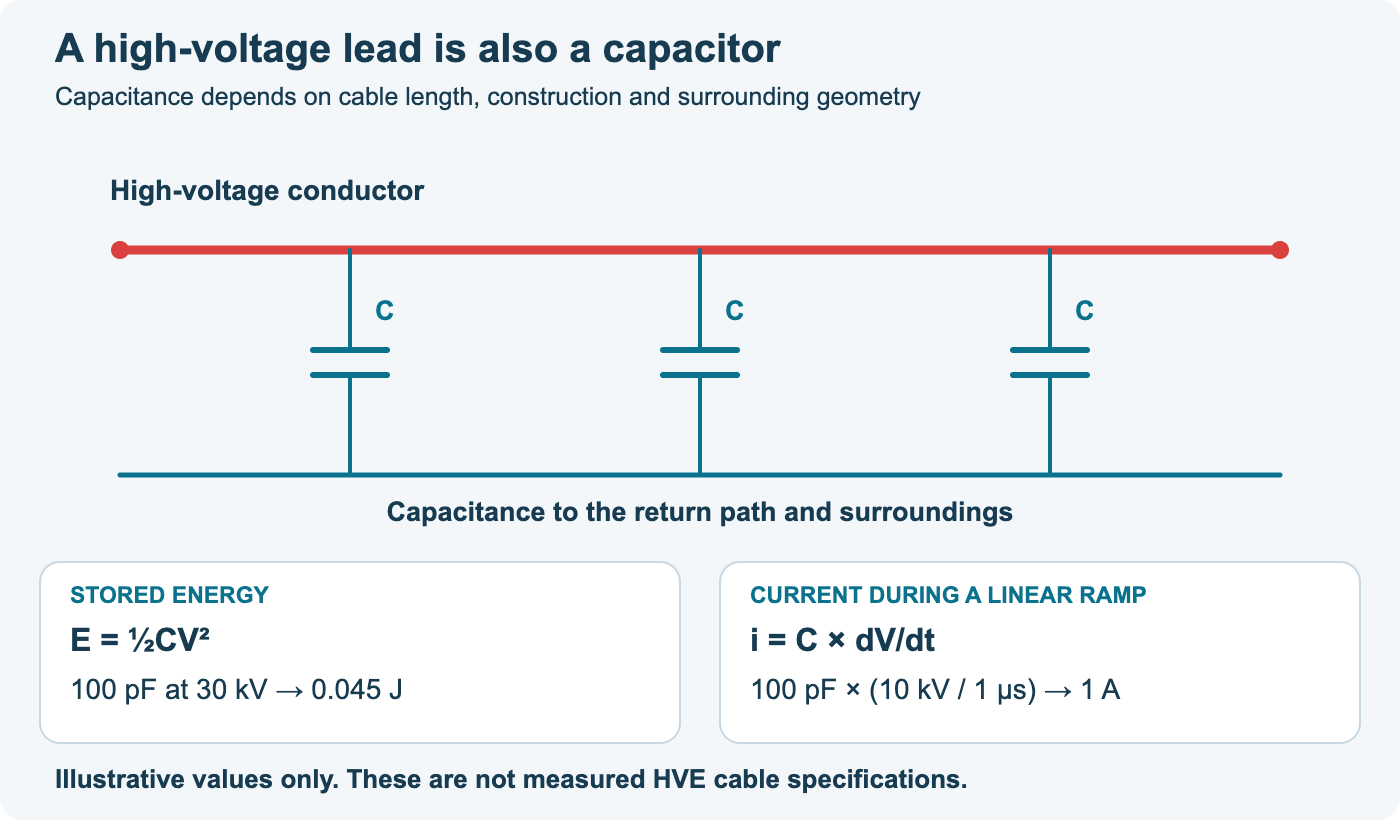
A high-voltage lead has capacitance to its surroundings and return path. With an unshielded cable, the value depends on the installed geometry as well as the cable itself. Longer leads commonly add more capacitance, and moving a lead closer to grounded metal changes the electric-field arrangement.
The basic relationships are:
E = ½CV²
i = C × dV/dt
The first describes stored energy; the second describes ideal capacitive current during a voltage transition. As an illustrative calculation, 100 pF of total cable capacitance at 30 kV stores 0.045 J. If that same capacitance experiences a linear 10 kV ramp lasting 1 µs, the ideal capacitive current is 1 A during the ramp. These are assumed circuit values, not measured capacitance or a pulse rating for any HVE cable.
Spellman’s cable-length application note discusses how cable capacitance can contribute stored energy and severe transients during an arc. Its coaxial-cable capacitance figures should not be assigned to these unshielded HVE leads. Keep routing as short as practical while preserving the required spacing and service access.
Include the cable and connected loads in the discharge procedure. A current-limited supply can still charge external capacitance, and switching the supply off does not prove that capacitance has discharged. Our bleeder resistor sizing guide explains the resistance, power and time calculations. Isolate the source and verify the equipment is discharged with a suitable rated measurement system before handling connections.
A practical selection checklist
- Define the electrical duty. Record maximum DC voltage, ripple, transients, current and any repetitive switching.
- Choose a documented cable construction. Compare the voltage rating, conductor, temperature range and required approvals.
- Plan the physical route. Allow for outside diameter, supports, bend requirements, strain relief and separation from other conductors.
- Design the complete connection. Check terminals, feedthroughs, enclosure and environmental conditions independently of the cable rating.
- Account for cable capacitance. Include its influence on switching, stored energy and discharge verification.
Start with the HVE high-voltage cable range to compare the available sizes. Silicone’s flexibility and temperature range make these cables practical building blocks; selecting the right voltage class and integrating the ends correctly turns those material benefits into a useful installation.
Common questions about silicone high-voltage cable
Is all silicone wire suitable for high voltage?
No. Silicone describes the insulation material, not the completed wire’s voltage rating. Low-voltage silicone hook-up wire must not be treated as 40 kV or 50 kV cable. Check the specific product’s construction and ratings.
What is the difference between HVE’s 40 kV and 50 kV cable?
Both use 22 AWG tinned stranded copper and list −55 to +150°C operation. The 40 kV cable has a 4.76 mm outside diameter; the 50 kV version is 5.76 mm. The higher DC voltage rating does not imply greater current capacity.
Does 100 kV cable carry more current?
The voltage number does not answer that question. HVE’s 100 kV cable has a different nominal conductor size and a much thicker layered insulation system, but permissible current still depends on heating, installation and connection limits.
Can I use DC-rated silicone cable on an AC flyback transformer?
Only when the cable’s suitability for that waveform has been established. Peak voltage, frequency, polarity reversal and repetitive stress matter. A DC rating cannot be converted into an AC approval by dividing by √2.
Will dielectric grease increase the cable’s voltage rating?
No. It may serve a defined sealing or interface function in a compatible termination, but it does not change the cable rating or replace suitable insulation, spacing and mechanical protection.
No comments yet. Be the first to start the conversation.